
Anatomy in Motion

Postural harmony begins from the foundation – the feet.

 
Anatomy in Motion

How does AIM work?

Through the integration of precise movements to achieve proper posture.


Through the integration of precise movements to achieve proper posture.

AIM is a method that brings a new way of thinking about anatomy and human body movement. This holistic kinesiotherapy approach views the body as a complete system, where every part influences the others. In AIM, movement is not divided into isolated parts but is considered as an integrated whole, acknowledging the interconnection of muscles, bones, ligaments, and the nervous system. AIM not only addresses physical functionality but also enhances proprioception (the body’s sense of space), which enables long-term changes.

The focus is on correcting asymmetries that are often distant from the body’s center. Work on the feet and hips is crucial because their correction initiates chain reactions that extend to the rest of the body, including the knees, hips, spine, and neck. This holistic approach, grounded in biomechanics and functional movement integration, restores optimal postural alignment and balance, reducing the risk of compensatory injuries and chronic pain.

Benefits and Advantages

Proprioception. Mobility. Control.

  • Improves body awareness during movement
  • Optimizes movement and balance
  • Prevents injuries
  • Accelerates recovery

Who is it for?

For limited mobility, postural imbalances, and sports optimization.

  • People with movement problems
    If you experience pain in your feet, knees, or hips that restricts movement.
  • Athletes
    For athletes who want to correct inefficient movement patterns and reduce the risk of injury.
  • After injuries or surgery
    When balance and walking confidence have been compromised by injuries or surgical procedures.
  • Those who want to improve posture
    If you wish to enhance body posture and increase stability.

What does a therapeutic session look like?

Controlled movements trigger postural chain reactions.

An AIM session begins with a detailed movement and posture assessment. The therapist first analyzes your body in a passive standing position, evaluating asymmetries and compensations that may affect your ability to move. The next step includes observing the body in active motion, such as walking, since walking is a complex process involving the whole body. Here, a specific movement pattern is sought, which may reveal dysfunctions in balance and coordination.

During treatment, the therapist applies various correction and mobilization techniques, focusing on the feet and hips, as these are the body’s key stability points. By targeting these areas, therapy triggers chain reactions affecting other body parts, including the knees, hips, and spine, thereby restoring proper postural balance. Exercises are performed slowly and precisely to allow correct motor unit activation and optimal movement coordination.

In each session, the client is also educated on how to apply learned exercises and corrections in daily life, ensuring long-term progress. The exercises are simple yet effective and can be practiced in short intervals throughout the day. This approach requires no special equipment or space, making it easy to integrate into everyday routines.


PAIN IS MORE THAN A SYMPTOM

Discover what lies beneath

 
Discover more


FROM PAIN TO PERFORMANCE

Questions & Answers

Anatomy in Motion

01How should I prepare for AIM therapy?


We recommend coming in comfortable clothing that allows free movement. The session includes exercises in various positions, including standing and walking, so it’s important that you feel at ease. No special equipment or footwear is required, as we will mainly focus on foot movements.

 
Anatomy in Motion

02Are there any side effects associated with AIM therapy?


AIM therapy is a safe method with minimal risk of side effects. However, as with any therapy involving physical activity, mild temporary symptoms may occur. Some clients may experience increased muscle tension, fatigue, or temporary discomfort in areas that were previously dysfunctional, as the body adapts to new movement patterns.

These reactions are usually short-lived and disappear within a few days, representing a normal part of the adaptation and motor reorganization process. It is important to note that AIM therapy does not cause any serious side effects when properly applied, as treatments are tailored to the client’s individual needs and condition.

 
Anatomy in Motion

03Why do we work on feet and hips when my back hurts?


AIM is a holistic kinesiotherapy approach to the body and movement. We see the body as a complete system in which every part influences the others.

Movement is observed as an integrated whole, respecting all parts of the locomotor system – muscles, bones, ligaments, and the nervous system – and their interaction. Instead of focusing on isolated areas, we emphasize the importance of understanding the cooperation of all body parts to enable effective locomotion.

 
Anatomy in Motion

04Why do we place wedges under the feet while performing certain body movements?


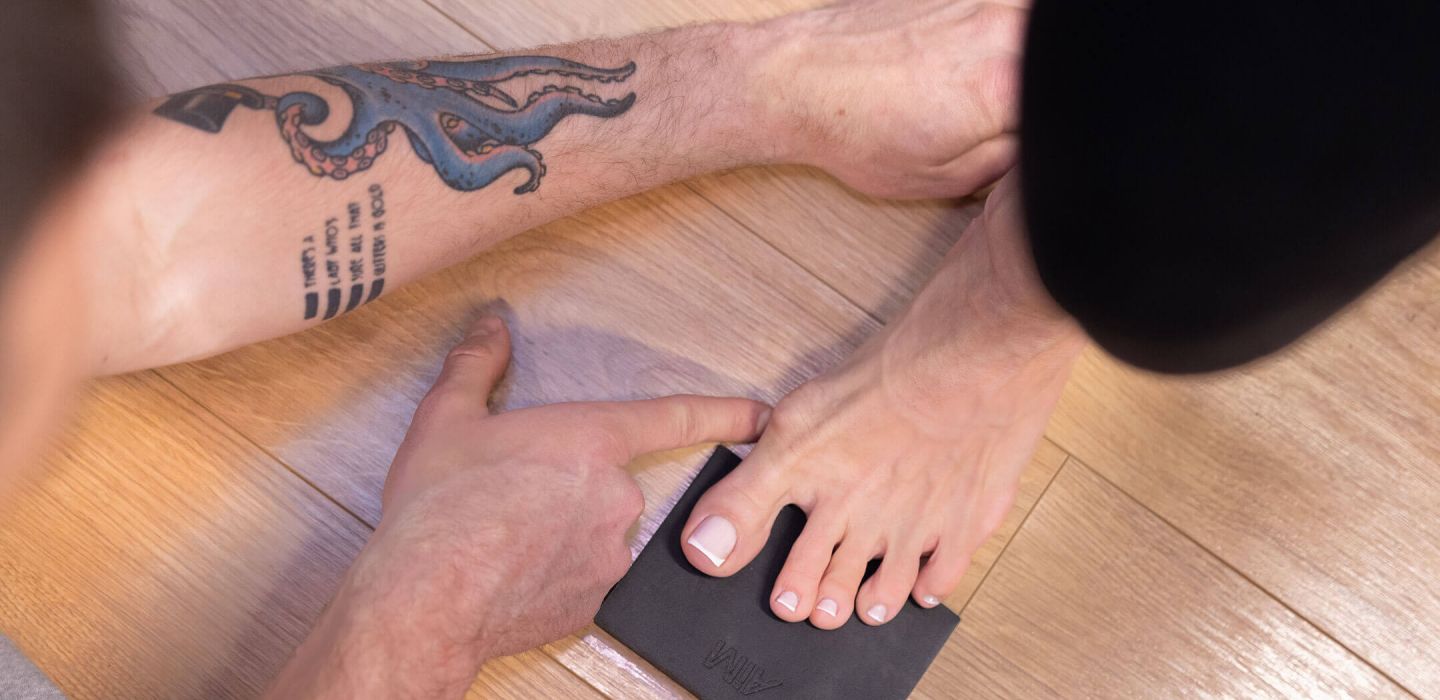
Wedges are used in AIM therapy to help correct body asymmetries. This process triggers proprioceptive stimulation, allowing the body to stabilize and connect movements functionally, reducing excessive stress on joints and muscles.

Movement is viewed as the coordinated motion of joints and their structures around the body’s “center.” During locomotion, as we shift from one side to the other, from front to back, and rotate, natural asymmetries may become pronounced.
Wedges help correct these asymmetries by guiding movements so the body exits imbalances.

Correcting foot position triggers chain reactions that alter the position and function of structures above them, such as the knees, hips, and even the cervical spine and head, achieving alignment of the entire body.

 
Anatomy in Motion

05Do I need to practice with wedges at home?


The exercises prescribed for you do not need to be performed with wedges but rather without any equipment, focusing primarily on the movement itself. The stimulus received through controlled practice with the therapist is sufficient to help correct motor patterns. Using wedges additionally at home risks overloading the musculoskeletal structures, potentially leading to pain.

 
Anatomy in Motion

06How do I know if I’m doing the exercise correctly?


The best answer is: if you feel the same body areas working during independent practice as when exercising with the therapist, you are doing it correctly. Additionally, you always have the option of asking your therapist to record a specific exercise to provide extra confidence when practicing alone.

The therapist will provide you with all necessary information during training to help you perform the exercises as correctly as possible on your own.